Portable Low-Cost AI Agent Terminal Technical Solution
This article introduces the portable AI agent terminal developed by Xi'an Boao Intelligent Technology Co., Ltd., based on ESP32-P4 main control chip, featuring a cloud-edge collaborative hybrid intelligence architecture with multimodal interaction capabilities for industrial, commercial, and service scenarios.
Portable Low-Cost AI Agent Terminal Technical Solution
Background and Industry Status
As large language models advance rapidly, artificial intelligence is transitioning from “cloud services” to “terminal entities.” However, the reality is that most AI capabilities remain confined to software applications or remote interfaces, requiring users to depend on networks, platforms, and complex systems. This makes AI difficult to deploy in many real-world business scenarios, especially in environments sensitive to real-time performance, stability, and cost.
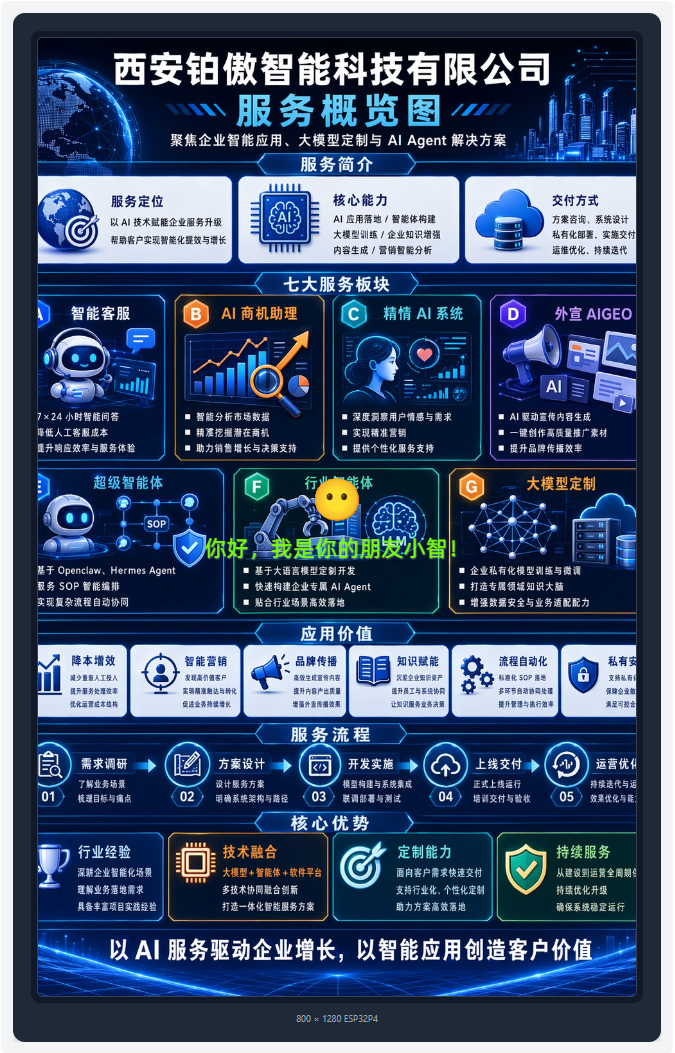
Based on this industry status quo, Xi’an Boao Intelligent Technology Co., Ltd. has designed and implemented a portable AI agent terminal for practical scenarios. This product is not a traditional development board or display device, but is built from the ground up around the goal of being an “agent execution载体” — integrating computing, sensing, and interaction capabilities within limited hardware resources, enabling AI to enter the real world in a deployable, accessible, and sustainable form, becoming a stable node in business processes rather than an occasionally invoked remote capability.
Hardware Architecture: ESP32-P4 Based Cloud-Edge Collaboration System
The device uses the ESP32-P4 as the core local computing unit, with a collaborative communication chip building a cloud-edge collaboration system. This enables the device to have basic multimedia processing and AI inference capabilities while maintaining low power consumption and low cost.
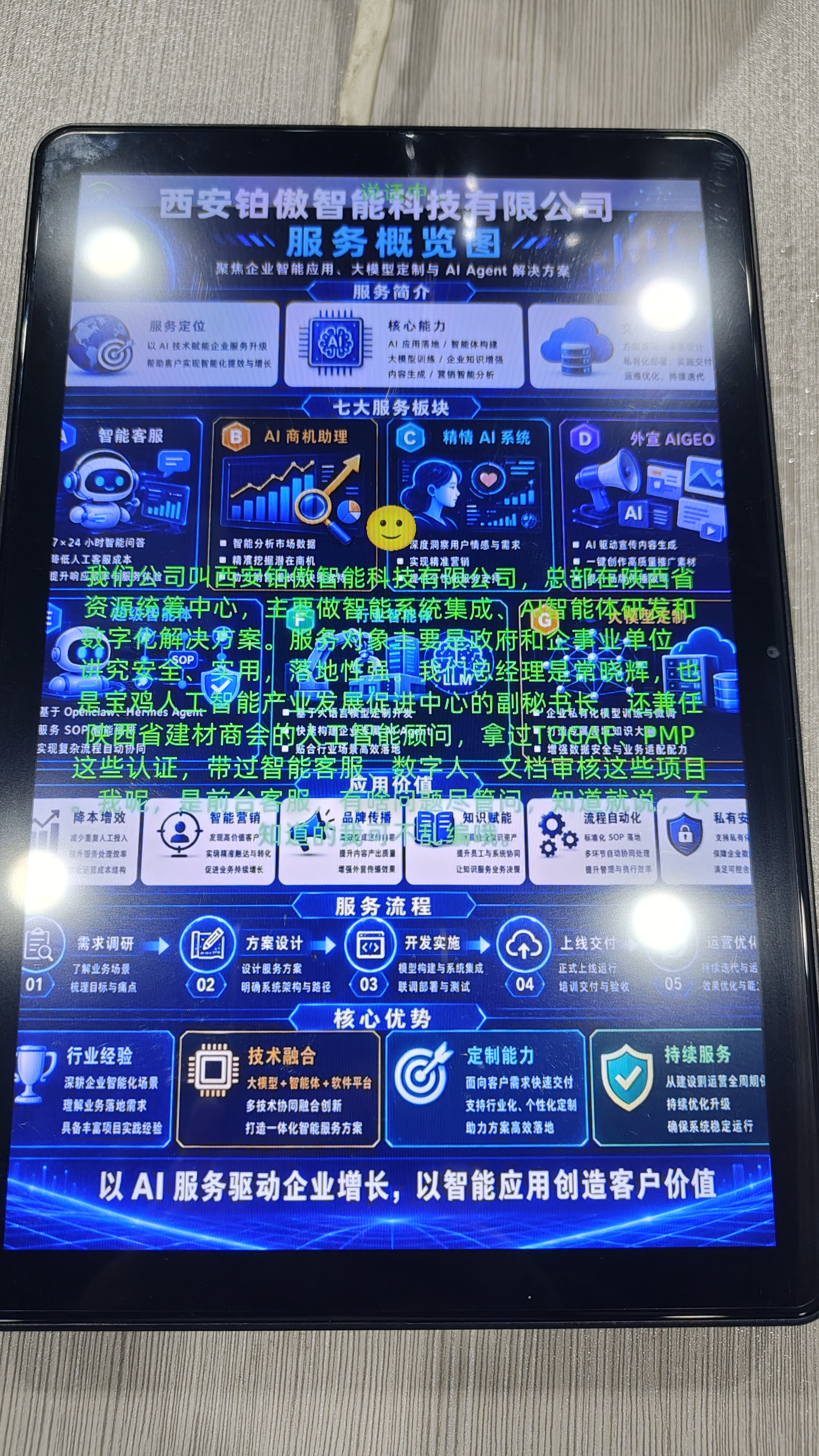
Core Hardware Specifications
| Module | Specification |
|---|---|
| Main Control Chip | ESP32-P4, dual-core processing |
| Image Processing | Integrated image processing hardware acceleration module |
| Audio Processing | Integrated audio processing hardware acceleration module |
| Communication Unit | Cloud service connection, supports complex inference calls |
| Power Consumption | Microcontroller architecture, low power design |
The main control chip provides dual-core processing capabilities and integrates image processing, audio processing, and various hardware acceleration modules, enabling it to handle basic visual data processing and voice signal processing tasks. The communication unit connects to cloud services and invokes large model capabilities when more complex inference is needed, forming a “local fast response + cloud capability extension” hybrid intelligence architecture. This design avoids dependency on high-performance processors and operating systems, controlling costs while retaining sufficient functional flexibility.
Dual Version Product Strategy
The product line includes two versions to adapt to different market needs:
- Standard Version: For general scenarios, providing complete sensing, interaction, and cloud collaboration capabilities
- OpenClaw Version (Longxia Edition): Meets custom agent development needs, pre-integrated with OpenClaw agent framework, supports developers in customizing skills, workflows, and business logic, providing more open secondary development interfaces
Multimodal Sensing and Interaction System
Around the agent operation needs, the device has a complete design for sensing and interaction layers. Through the combination of camera interface, microphone, speaker, and touchscreen, the device has multimodal input and output capabilities, processing voice, images, and user operations simultaneously, forming a closed-loop human-machine interaction system.
Sensing Layer Capabilities
- Sound Collection: High-sensitivity microphone array, supports voice command recognition
- Image Collection: Camera interface, supports face recognition, object detection, and visual navigation
- User Operation: Touchscreen, provides intuitive graphical interaction interface
In this system, users no longer need to rely on keyboards or complex interfaces, but can communicate with the device directly through natural language. The device can also provide feedback through voice or interface, making interaction more intuitive and efficient.
Three-Layer System Architecture
We abstract the device capabilities into three layers: Sensing Layer, Local Intelligence Layer, and Cloud Collaboration Layer:
flowchart TD
    subgraph SensingLayer
        A[Sound Acquisition] --> |Environmental Data| E[Sensing Layer]
        B[Image Acquisition] --> |Environmental Data| E
        C[User Operation] --> |Environmental Data| E
    end

    subgraph LocalIntelligenceLayer
        E --> F[Data Preprocessing]
        F --> G[Lightweight Inference]
        G --> H[Real-time Decision Making]
    end

    subgraph CloudCollaborationLayer
        H --> |Complex Analysis Request| I[Cloud Large Model]
        I --> |Inference Results| H
        H --> |Cross-system Data| J[Business System Interface]
        J --> |Data Sync| H
    end
| Layer | Responsibilities | Capability Features |
|---|---|---|
| Sensing Layer | Collect environmental data (sound, image, user operation) | Multimodal data acquisition interface |
| Local Intelligence Layer | Data preprocessing, lightweight inference, real-time decision | Available offline with basic capabilities |
| Cloud Collaboration Layer | Complex analysis, cross-system data interfaces, remote large models | Cloud capability extension |
This layered design achieves a balance between response speed, stability, and intelligence, while providing a clear structural foundation for future expansion.
Industry Application Scenarios
Industrial Manufacturing and Production Line Management
In engineering management and production line scenarios, traditional information acquisition methods rely on manual reporting or system queries. Although data is digitized, access paths are complex and lack real-time capabilities. By deploying this AI agent terminal, the device connects directly to production systems and remains on-site. Managers can query production line status, equipment operation, or exception information in real-time via voice. The device returns results immediately by combining local cache and cloud data interfaces, transforming “checking data” into “conversational information acquisition,” significantly improving efficiency.
Visual Recognition and Position Management
With visual capabilities, the device can participate in specific management processes:
- Face Recognition: Employee login, shift confirmation, attendance check-in, with recognition results automatically linked to backend systems, reducing manual operations
- Exception Detection: Identification and alerts for unauthorized personnel operations, position vacancies, abnormal停留, etc.
- Management Assistance: Carrying certain management assistance functions beyond information collection
Multi-process Collaboration and Real-time Coordination
In multi-process collaborative production environments, the device can serve as a real-time coordination node. By continuously receiving various status information and detecting delays or exceptions, it proactively alerts relevant personnel through voice or interface, while providing reference suggestions based on historical data or rule analysis. Compared to traditional alarm systems, this emphasizes “information interpretation and decision support,” helping on-site personnel understand problems faster and take action, reducing communication costs and decision delays.
Commercial Retail and Service Industry
- Shopping Guide Terminal: A visual and voice-enabled shopping guide terminal that provides product recommendations by recognizing user behavior and combining with conversation
- Enterprise Internal Assistant: A lightweight AI entry point helping employees complete information queries, process triggers, or daily records
- Education and Development Platform: A low-threshold experimental platform enabling developers to quickly build and verify agent applications
Cost Advantages and Scalable Deployment Feasibility
This solution has significant advantages compared to traditional AI terminals. By adopting a microcontroller architecture and optimizing the multimedia processing pipeline, the device greatly reduces hardware costs and power consumption while ensuring complete basic functionality, making large-scale deployment feasible.
This advantage is particularly critical for industries needing large-scale terminal deployment. According to industry data, the edge AI device market maintained rapid growth in 2025, with market size expected to exceed $5 billion by 2026. Only when costs are controllable can AI capabilities truly transition from “pilot applications” to “infrastructure.”
Technical Validation and Future Planning
The product has completed hardware design and basic system validation, with multimodal input capabilities and basic interaction processes running stably. The agent system framework continues to be optimized.
Key Future Directions
- Local Model Capability Enhancement: Enhance local inference capabilities, reducing dependence on the cloud
- Agent Framework Standardization: Improve the agent operation framework, supporting more scenario migration
- Industry Solution Deployment: Promote practical applications in industrial, commercial, and educational sectors
- Cost Structure Optimization: Further reduce hardware costs and optimize deployment methods
Conclusion
This portable AI agent terminal is not merely a hardware device, but an exploration of future AI form. When artificial intelligence is no longer confined to cloud interfaces or software applications, but appears in specific scenarios as a physical device capable of continuous operation and interaction, what it brings is not only efficiency improvement, but the restructuring of entire business processes and human-machine relationships.
Xi’an Boao Intelligent Technology hopes that through this terminal, AI can transform from “an invocable capability” to “a reliable presence,” exerting long-term value in more real-world scenarios.
Related Links
- Official Website: www.boaoai.cn
- Product Consultation: Contact Xi’an Boao Intelligent for detailed solutions
- Technical Support: Agent framework built on the OpenClaw platform
Tags: AI Agent | ESP32-P4 | Edge Computing | Cloud-Edge Collaboration | IoT | Smart Manufacturing | Xi’an Boao